PCE (Tetrachloroethene) Toxic Substance FOUND
2/22/2024: PCE was detected in both soil gas samples analyzed at concentrations of 9,660 micrograms per cubic meter(µg/m3) and 13,000 µg/m3, in samples B36-5 and B36-10, respectively. Reported concentrations exceeded the commercial/industrial SGSL of 67 µg/m3, which is based on an 0.03 attenuation factor applicable for site screening purposes.
Present in soil, soil gas and groundwater samples - testing indicates on-site release Soil gas concentrations (used to test vapors in air) exceeded commercial/industrial SGSL.
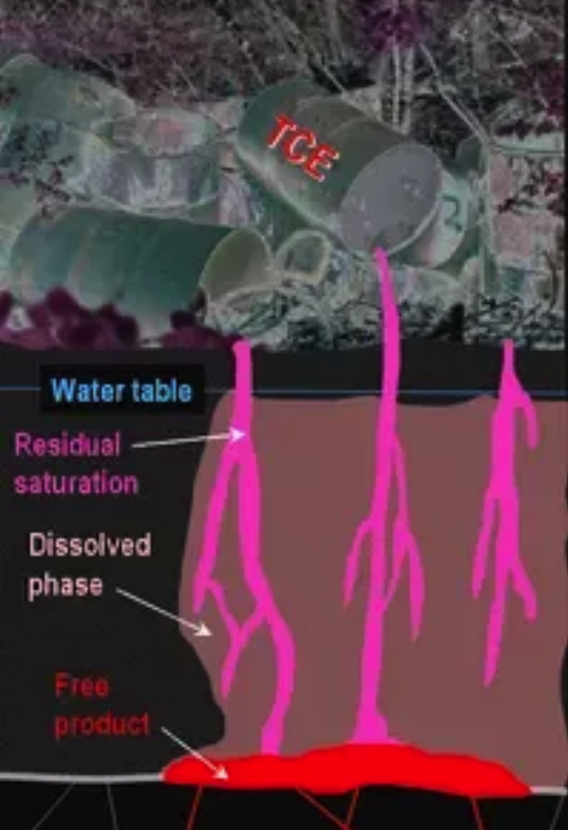
Substance: PCE is a dense, volatile hydrocarbon in the liquid form, widely used as a degreaser and in dry cleaning, and such releases often lead to long-term environmental contamination
Reported PCE concentrations in groundwater exceeded the MCL of 5.0 ug/L Possible on-site release of PCEs - this means discharge of this chemical into the environment—soil, groundwater, or air—at the location where it is used, stored, or handled.
Possible off-site contribution to the soil vapor impacts beneath the site, with tests indicating there is likely a separate contamination plume/source.
Exposure Pathways & Community Considerations: PCE often leaks into soil and groundwater, forming long lasting plume contamination. Plume contamination can lead into PCEs sinking deep into aquifers and can cause drinking water contamination
Risk to Human Health: Prolonged exposure is linked to central nervous system (CNS) depression, kidney/liver damage and cancer.
This report presents a summary of work conducted by PARTNER. The work includes observations of site conditions encountered and the analytical results provided by an independent third-party laboratory of samples collected during the course of the project. The number and location of samples were selected to provide the required information. It cannot be assumed that the limited available data are representative of subsurface conditions in areas not sampled.
Conclusions and/or recommendations are based on the observations, laboratory analyses, and the governing regulations. Conclusions and/or recommendations beyond those stated and reported here in should not be inferred from this document.Partner warrants that the environmental consulting services contained herein were accomplished in accordance with generally accepted practices in the environmental engineering, science, geology, and hydrogeology fields that existed at the time and location of work.
- Footnotes:
Center of Disease Control: https://www.atsdr.cdc.gov/toxguides/toxguide-2.pdf
National Library of Medicine: https://www.ncbi.nlm.nih.gov/books/NBK609355/
Environmental Protection Agency: https://www.epa.gov/ccl/ccl-4-chemical-contaminants
EPA https://www.epa.gov/sites/default/files/2016-09/documents/tetrachloroethylene.pdf
National Library of Medicine: https://pmc.ncbi.nlm.nih.gov/articles/PMC3984230/
National Library of Medicine: Exposure Pathways https://www.ncbi.nlm.nih.gov/books/NBK225345/
EPA: Vapor Intrusion https://www.epa.gov/vaporintrusion/what-vapor-intrusion
CDC: https://wwwn.cdc.gov/TSP/ToxFAQs/ToxFAQsDetails.aspx?faqid=160&toxid=29
CDC: https://www.atsdr.cdc.gov/toxfaqs/tfacts3.pdf