Sacred Ground
Review of historical aerial photographs indicated that the Project site was undeveloped circa 1896; developed with agricultural land (row crops) and three shed-like structures along the southern border of the site from 1927 to 1960; vacant land from 1963 to 1972; and developed with the current lumber yard and associated structures in 1975 and 1994.
There is no indication that human remains are present within the Project site, and the SCCIC records search did not identify evidence of human remains within the 0.5-mile search radius of the site. However, construction activities may unearth previously undiscovered human remains.
On October 2, 2024, Psomas completed a record search for the Project site, which included a0.8-kilometer (0.5-mile) radius around the site. The purpose of the literature search was to identify prehistoric or historic archaeological sites or historic buildings and structures, previously recorded within and around the Project site. The SCCIC record search identified9 prior cultural resources studies within the 0.5-mile search, 2 of which were identified within the Project site, as shown below in Table 15, Cultural Resource Studies within 0.5-mile of the Project site.
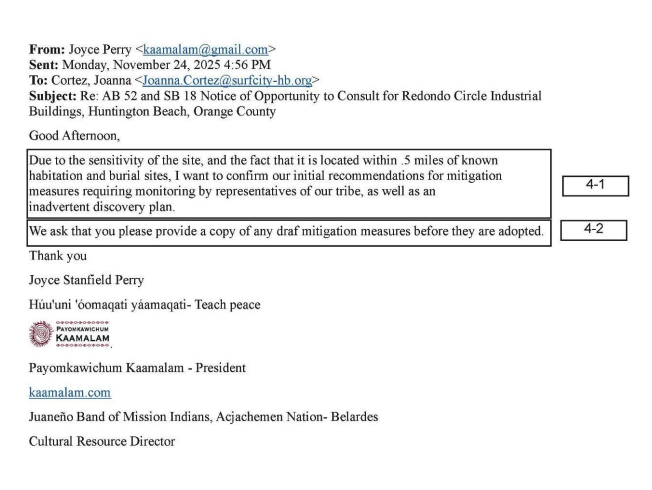
In response to comment LU/SBC-1 by Juaneño Band of Mission Indians, Acjachemen Nation– Belardes, regarding selection of a Native American Monitor (MM TCR-1), the City recommends selecting two monitors, one from each of the two tribes and modifying the text of MM TCR-1 to reflect that.
The following revisions to the text of MM TCR-1, A., on page 8-145 in Section 8.18, Tribal Cultural Resources of the IS/MND are hereby made to read as follows (deleted text is shown in red strikethrough while new text is shown in red italics):Mitigation MeasuresMM TCR-1 Retention of a Native American Monitor Prior to Commencement ofGround-Disturbing ActivitiesA. The Project Applicant shall retain a two Native American Monitors one from Gabrieleno Band of Mission Indians – Kizh Nation and one from Juaneño Band of Mission Indians, Acjachemen Nation – Belardes prior to the commencement of any ground-disturbing activity for the subject Project at all project locations (i.e., both on-site and any off-site locations that are included in the project description/definition and/or required in connection with the project, such as public improvement work). “Ground-disturbing activity” shall include, but is not limited to, demolition, pavement removal, potholing, auguring, grubbing, tree removal, boring, grading, excavation, drilling, and trenching.