State Housing Mandates
State Housing Mandates have significantly eroded local land-use authority, supplanting community-based planning with rigid, top-down rules. Residents experience a loss of meaningful input; even as local officials remain legally responsible for compliance. Streamlined approvals frequently bypass public hearings and local design standards, shift liability to cities, and prioritize building over neighborhood character.
Collaboration must extend beyond government agencies to the residents they serve. As Sacramento lawmakers continue to enact significant housing legislation, much of it with direct consequences for zoning, density, local control and neighborhood character development standards, the public must be informed and involved. Cities, working through OCCOG and SCAG, have an important role in educating residents about new laws, explaining their local impacts, and encouraging constituents to register their views with State Representatives. Improving public awareness not only strengthens transparency and trust but also ensures that community perspectives are included in shaping future housing policy.
By September 1, 2026, the City of Huntington Beach should evaluate submitting an appropriate Housing Element to reduce potential exposure to HCD penalties.
Full Report found HERE The Southern California Association of Governments (SCAG) serves as the regional planning agency for Southern California, coordinating among local, regional, state, and federal partners to advance transportation, housing, land-use, and environmental planning that supports sustainable growth, economic vitality, social equity, and improved quality of life for the region’s diverse communities.
The practical elimination of traditional single-family zoning and the widespread up-zoning of existing neighborhoods threaten longstanding community character while limiting local oversight of height, density, parking, and environmental resilience.
The Southern California Association of Governments (SCAG) determines the RHNA housing allocation for most of Southern California. Within this framework, the Orange County Council of Governments (OCCOG) serves as the County’s representative to SCAG in the RHNA process. The RHNA methodology and resulting allocations have been widely criticized as unrealistic, inequitable, and insufficiently transparent.1OCCOG’s level of influence with SCAG is critical to regional planning outcomes. OCCOG needs substantial funding increases to better advocate in Sacramento and within SCAG to support OC jurisdictions.
The Housing Element Law (Government Code 65580-65589.11), originally adopted in 1969, remains the foundation of California’s housing policy. The law requires every city and county to prepare a Housing Element as part of its General Plan that identifies how the jurisdiction will meet the housing needs of all income groups.4 The RHNA process implements these Housing Mandates by assigning each jurisdiction a specified number of housing units—categorized by income level. Compliance is tied to eligibility for state housing and transportation funding, creating substantial financial implications for the County of Orange and its 34 municipalities.
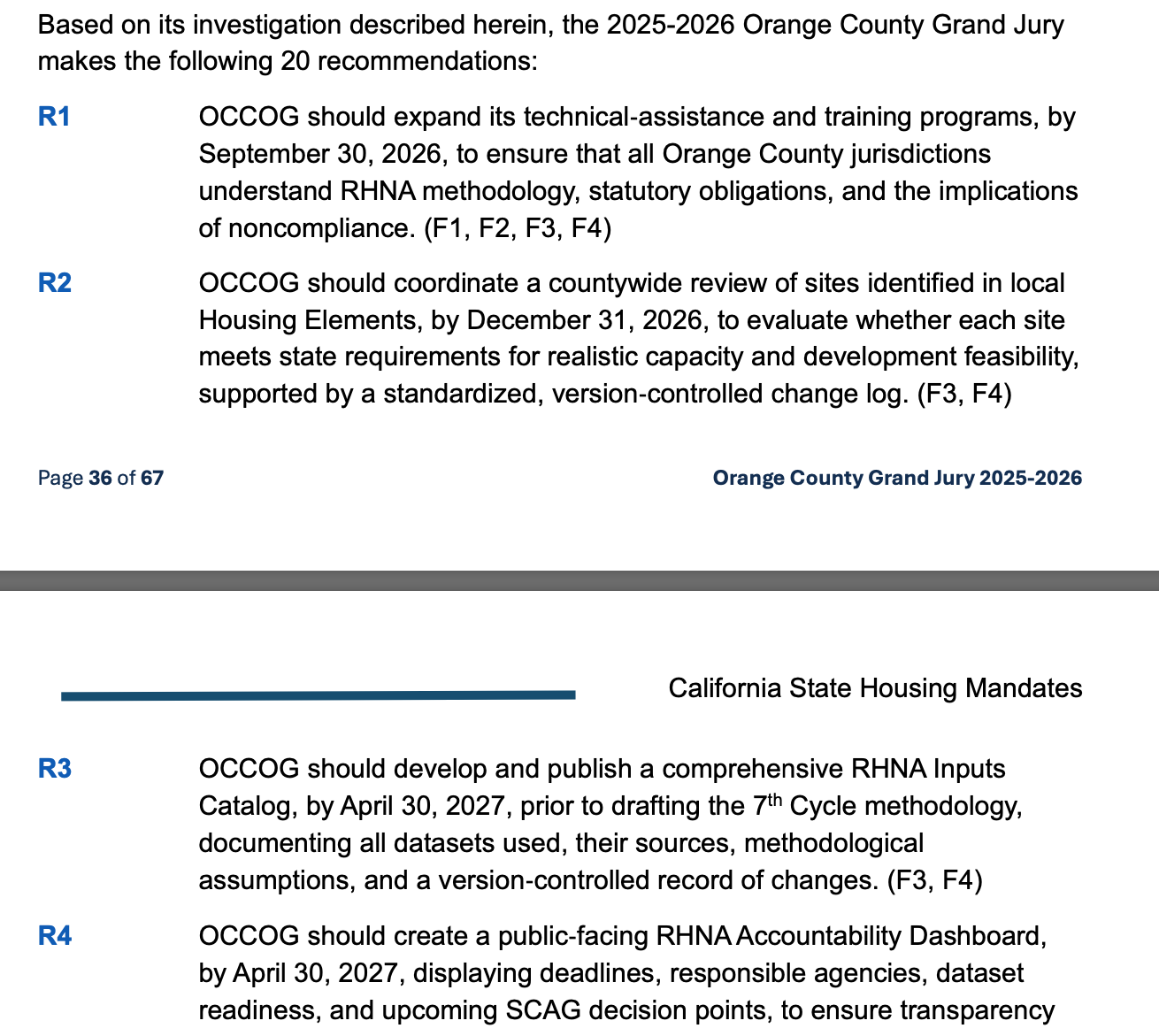
Within this context, this report does not question whether cities must comply with state housing law—they must—but rather this report’s objective is to assist Orange County jurisdictions and the public in understanding the framework within which they operate and enhance the possibility of good planning practices and design. During interviews, city officials and builders described to the OCGJ the benefits of citizen engagement, proactive and early coordination on planning, realistic site inventories, and timely engagement with state agencies to avoid punitive actions. Public communication and civic education is essential. Several Orange County cities reported undertaking efforts to engage residents and explain how the Housing Mandates affect local decision-making authority, including reductions in traditional zoning discretion. Transparent public outreach was identified as an important practice for maintaining community trust and managing expectations in an era of constrained local control.
Recent laws have made it simpler to construct housing by scaling back environmental controls.20 While this may accelerate development, it also threatens to weaken important environmental protections that California has relied on for decades. And importantly, there is no guarantee that these streamlined projects will provide affordable homes or meaningfully improve the housing crisis.
- By December 31, 2026, the Orange County Board of Supervisors should partner with cities to evaluate countywide infrastructure capacity— including water, wastewater, flood control, transportation, and public-safety systems—and develop a coordinated regional plan capable of supporting the level of housing growth required under state law. (F6)